

NEWS

IPSI-10 Public Forum Brings Diverse Voices Together on Mountain Conservation
2026.03.30
By Fausto Sarmiento1 and Alden Yépez2
1Neotropical Montology Collaboratory, University of Georgia (UGA)
2Archeology of Water and Glaciers Lab, Pontifical Catholic University of Ecuador (PUCE)
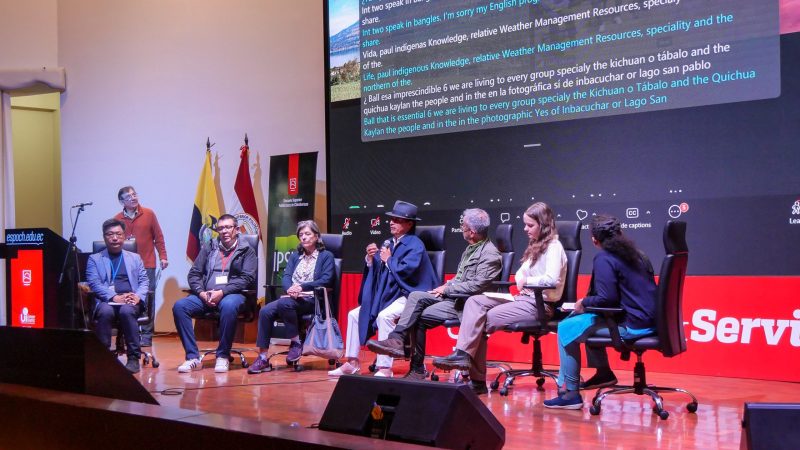
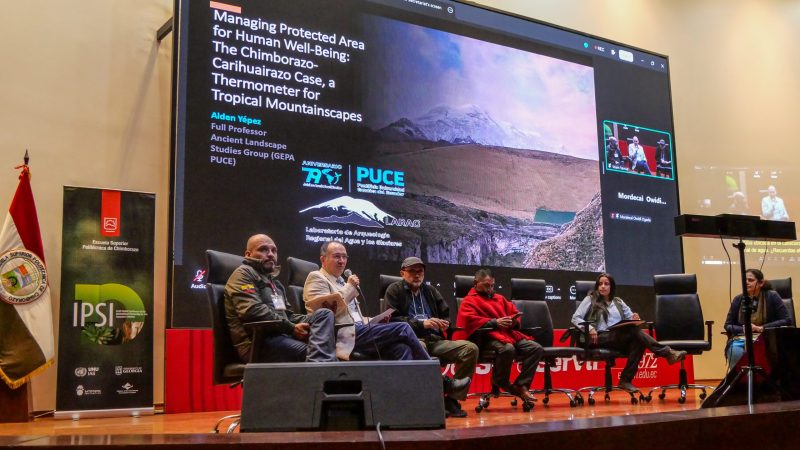
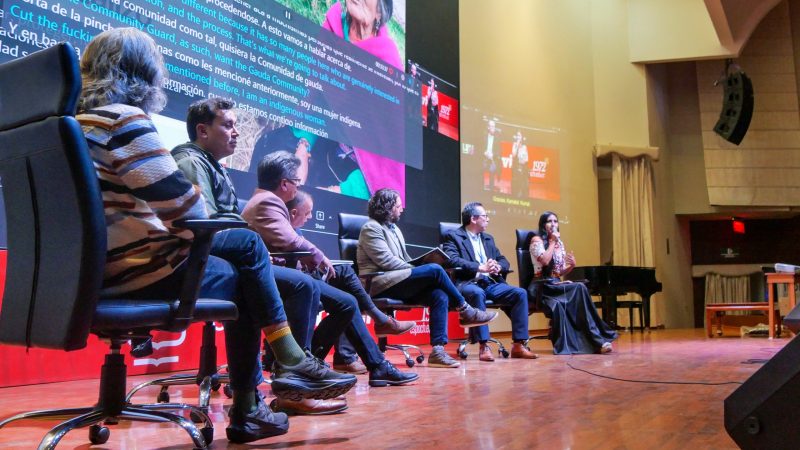
On 4 March 2026, the Public Forum of the Tenth IPSI Global Conference (IPSI-10) was held at the Escuela Superior Politécnica de Chimborazo (ESPOCH) in Riobamba, Ecuador, under the theme Conservation in Mountain Landscapes and Sustainable Ecotourism.
The forum brought together a broad audience, in person and online, including local experts, ESPOCH faculty and students and citizens of Riobamba. Opening presentations by Fausto Sarmiento (Professor, UGA) and Suneetha Subramanian (Research Fellow, UNU-IAS/IPSI Secretariat) the conceptual framing, introducing Montology, biocultural heritage and regenerative development to strengthen SDGs in socio-ecological production landscapes and seascapes (SEPLS).
Across three plenary sessions, 21 delivered brief exposés followed by discussions with the audience. The diversity of perspectives reflected a strong commitment to transdisciplinary dialogues, further enriched by a parallel poster session showcasing IPSI members’ activities.
Ana María Varea (former UNDP Ecuador) delivered a speech that was warmly applauded and raised concerns over illegal mining and the institutional merger of the Ministry of Environment with the Ministry of Energy and Mines. Carlos Jara (Dean, Faculty of Natural Resources, ESPOCH) presented on environmental degradation in Lake Yambo and the limited efforts to recover its waters. Through Alejandro Aguayo (Chimborazo Wildlife Production Reserve; RPFCH), we sadly learned that Chimborazo Reserve would be proposed as a natural heritage site for UNESCO’s Indicative List without recognition of its ancestral sociocultural legacies.
Luis Suárez (Former Director, Conservation International Ecuador) recalled the usefulness of past co-financed forest conservation programmes in Ecuador and questioned the current lack of incentives. Chadley Hollas (Ecotourism and Precarity Researcher, UGA) examined ecotourism’s potential against rural precarity in mountainscapes. Jaime López (Professor, University San Francisco de Quito) outlined challenges in transitioning the Galapagos to a SEPLS framework, while Patricio Mena (Andean Researcher, ECOCIENCIA NGO) noted ongoing environmental education on páramos conservation. Alejandra Razo (Research Coordinator, Sumak Kawsay Research Center In Situ) emphasized biodiversity conservation on Andean flanks, and Mordecai Ogada (Executive Director, Conservation Solutions Afrika) shared related experiences from Africa.
Grounded in action and cultural continuity, several presentations. Renato Chávez (Professor, ESPOCH) showed medicinal plant collections along the Qhapak Ñan (Andean Road System), while Olmedo Cayambe (Indigenous Community Representative, RPFCH) shared successes in strengthening Indigenous communities in the Chimborazo mountain. Alden Yépez (Professor, PUCE) noted that the delineation of zones under cryospheric influence remains a viable methodological strategy for anticipating and countering extractive pressures generated by accelerating glacial retreat. Juan Manuel Carrión (Scientific Illustrator, Charles Darwin Foundation) emphasized that art is intuition that leads us to science and consciousness. César Cotacachi (Indigenous environmental leader, Imbakucha Sacred Landscape and Imbabura Global GeoPark) described the cultural gradient of Mount Imbabura and the ancestral spirituality of its inhabitants. Conservation actions in pursuit of sustainability were presented by Jack Rodríguez (Executive Director, Ecosustainable Ecuadorian Amazon Foundation) on livestock farming to reduce pressure on ecosystems, by Sidney Eigeman (Researcher, UGA) on hydrology investigations in Zuñac town, and by Chimborazo ecotourism projects by Alex Gavilanez (Professor, ESPOCH) and Danny Castillo (Professor, ESPOCH).
Nathaly Pilamunga (Puruwa Women for Environmental Communication), of the Kichwa-Puruwa nation, evoked the words of Dolores Cacuango: “We are like the straw of the páramo that is pulled up and grows back… and with the straw of the páramo we will sow the world”. This message of resilience was echoed by both Chen-Fa Wu (Professor, National Chung Hsing University) and Engin Yilmaz (Executive Director, Yolda Initiative), who showed how persistence can place sustainability on international agendas.
After the forum, IPSI members visited either the Mount Chimborazo Reserve or the cultural village of Guano. Upon returning from the excursion, we felt that we had planted a seed at the base of Chimborazo, a memory that perpetuates the cognitive legacies of montology and this successful South American meeting for the Satoyama Initiative.