Socio-economic, Environmental and Biodiversity Impact of Boke Khola Sub-project in Triveni
15.04.2026
-
SUBMITTING ORGANIZATION
-
Team Organizing Local Institution (TOLI)
-
DATE OF SUBMISSION
-
January 2026
-
REGION
-
Asia
-
COUNTRY
-
Nepal
-
KEYWORDS
-
Conservation, Biodiversity, Conservation, Socio-economic, Forest, Watershed
-
AUTHORS
-
a. Mr. Padma Kiran Rana, Chairperson of TOLI/Sustainable Agriculture Expert and Ex-Province Manager of Koshi Province for Nepal Agricultural Services Development Program (NASDP)/HELVETAS Nepal
b. Mr. Dev Raj Gautam, Technical Advisor of TOLI/Local Consultant (Senior Policy and Institutional Expert) for JICA's Project for Climate Change Adaptation through Sustainable Forest Management in Nepal c. Mr. Rudra Bahadur Neupane, Advisor of TOLI, Program Manager in Phase Nepal d. Mr. Thakur Giri, Forestry Technician, Executive Member of TOLI
Summary Sheet
The summary sheet for this case study is available here.
Background
After, Nepal adopted the federalization in 2017, Parbat district has 2 Municipalities and 5 RuralMunicipalities. Out of them, Paiyu Rural Municipality is one, which is located in southern part of thedistrict. It is also adjoining with Syangja district. It comprises total 7 wards with total area of 43 km2.This case study includes the post-project status of Boke Khola Stream Control sub-project.
Boke Khola1 (Khola means stream), the case study site lies in Ward No. 2 (former Triveni Village Development Committee). This ward adjoins with the Syangja district and having north faces. The altitude of this ward ranges from 650 m to 1600 m above sea level (masl). The southern part includes high hills with dense vegetation and scattered settlements, whereas lower altitude areas is in north parts with irrigated lands with dense settlement areas, which is called Triveni and Arthun. The Paiyu Khola flows from east to west in the boarder of ward no. 2 and 3, whereas Boke Khola flows from south to north and finally merges into the Paiyu Khola.
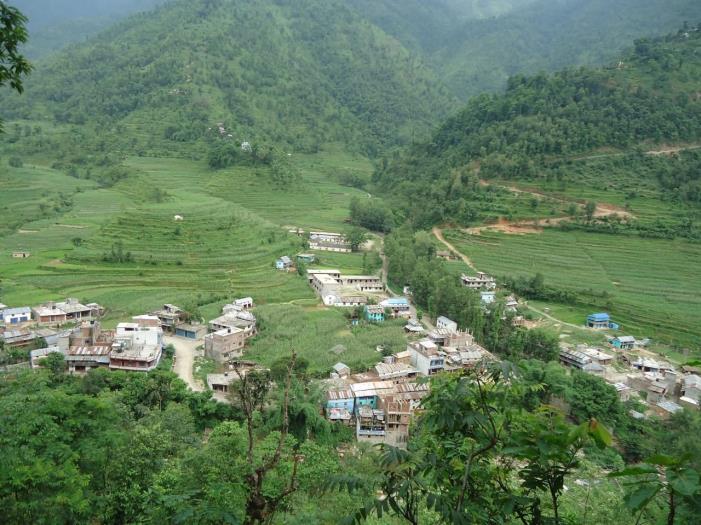
1Khola means stream
Socioeconomic, environmental characteristics of Bokekhola Community (including benefits and threats to human-nature relationships)
This study site includes a total of 417 household (hhs). Total population comprises 795 men and 827 women. Major domination of the caste and ethnicities are Brahmin, Magar, Bishwakarma, Pariyar, Thakuri, Gurung, Chhetri, Mijar, Newar & Sanyasi respectively (CBS, 2021).
The community people of this ward mostly rely on agriculture and holding on an average 0.5 ha of land (agriculture census 2021), few livestock like buffaloes, cattle, goat, and chicken. Remarkable populations are in foreign employment, service holders in government and non-government organizations. Similarly, very limited numbers of population are engaging in trader, mason, carpenter, driver, electrician, plumber etc. Men and women percentage in economy engagement in this ward is 55 and 45 respectively. There were 57.53 % of independent population, the working age people between ages of 15 to 64 years. The dependent children, ages below 15 years, were 34.90 %. (Nepal Economic census 2018)
Boke Khola is a small but permanent stream. It emerges from two sources of water called; i. Dodare Khola ii. Bhaisi Gaira. Length of this stream is about 3.5 KM. The top part of this stream is in about 1600 msl, whereas it mixes at the point of 650 m asl i.e. Paiyu Khola. Out of the total length of this stream, the first 2.5 KM of the stream crosses through the forest and hard rock, which is steep slope, whereas the 1 KM crosses through cultivated lands and residential areas and relatively less slope. More damages found due to flood in the cultivated and resident areas. The cultivated land and resident areas was made up of the deposition of soil and aggregates of the stream over a long time. So, cultivated land and resident areas are relatively fragile in nature.
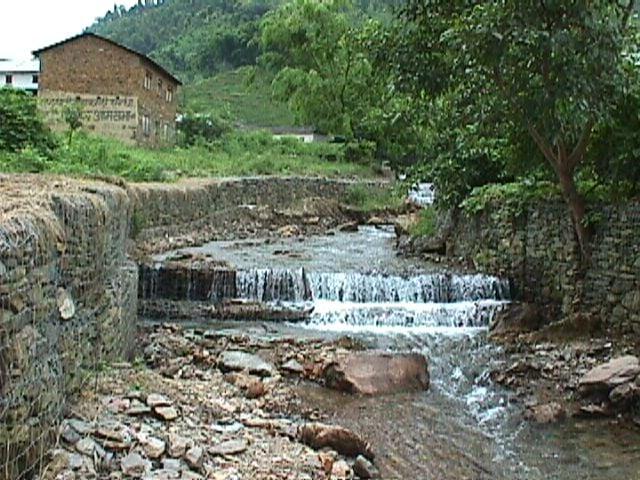
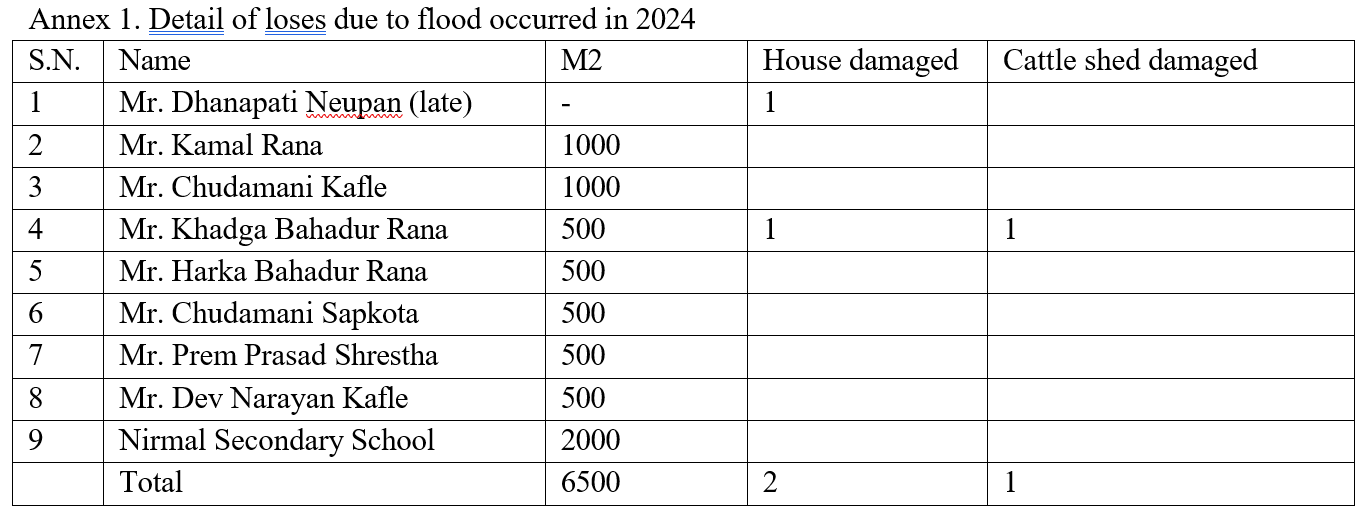
Based on the key informant’s information; some sections of Boke Khola sub-project that was constructed through JICA’s project was damaged by the flood/erosion in 2024 that adversely eroded total 6500 m2 land of 8 families and one public school. Similarly, it damaged two houses, one cattle shed, eroded about 200 m irrigation canal alignment and threatened to 13 HHs and secondary school.
(Annex 1 Name list of HH & institution damaged land, houses and cattle shed)
Objective and rationale
Objectives:
Major objective of the study was to understand how community owned sub-project can be sustained for the longer run by their own management after phasing out the project.
The specific objectives of this study were as follows::
1. To assess the changes in the socio-economic condition of the community people after completion of the scheme
2. To assess the impact of the Boke Khola sub-project in the biodiversity conservation and ecosystem
Rationale
The community people were very much enthusiastic while carrying out of various kind of activities in then Triveni VDC jointly by the government of Nepal (GoN)/Japanese International Cooperation Agency (JICA)/Community Development, Forest/watershed Conservation Project (CDFWCP) and Japanese Overseas Cooperation Volunteer (JOCV)/Greenery Promotion Cooperation Project (GPCP) phase I.
Out of them Boke Khola sub-project was one of the biggest sub-projects in that VDC. The activities carried by the project were through need based approach. Moreover, the project was envisaged to involve at least 50% of women in each of the decision making and benefits sharing level. In the case of user’s committee of the Boke Khola sub-project, there was 44% representation from the women. TOLI as a project partner, it is essential to know the impact and status of the community people after phasing out of the project. So, we decided to study the impact of Boke Khola sub-project.
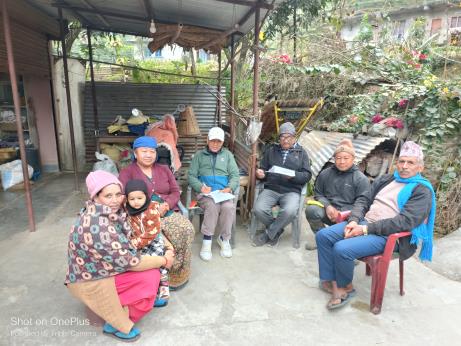
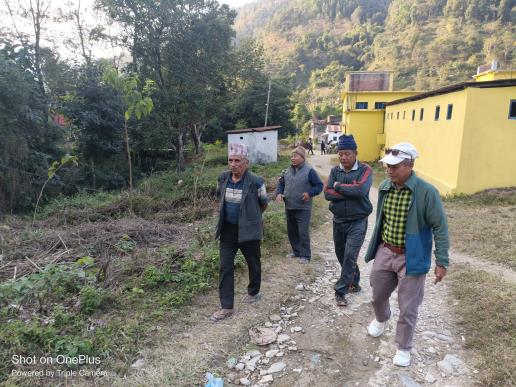
Then the team prepared the checklist to collect the required data and information. The team accordingly informed to then user’s committee chairperson of Boke Khola sub-project in Triveni Parbat district and collected information from November 20 – 22, 2025. We organized focused group discussion with user’s committee members and observed Boke Khola sub-project areas from downstream to upstream area with recalling previous events, because it was already 27 years of completion. We both visiting team members had involved during constructing period of that scheme as the project staff.
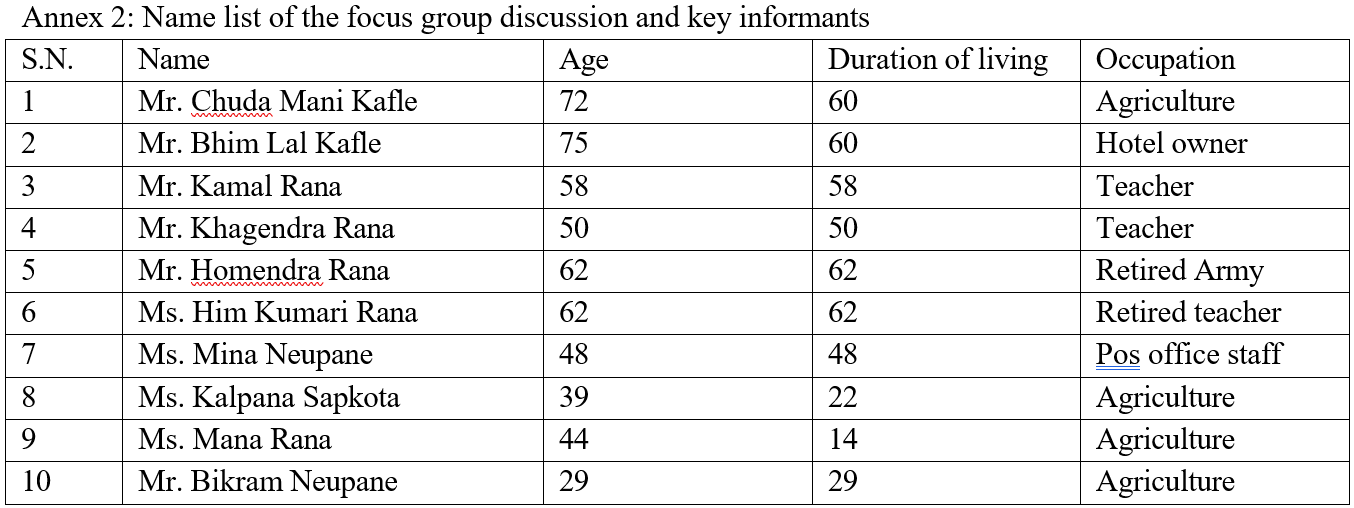
Likewise, we also took physical measurement about structures in the damaged areas with user’s committee members in details and collected remaining information with user’s committee members and other individuals (Annex 2: List of focus group discussion and key informants). Later, we analyzed the data and information to prepare this case study.
When, we visited that sub-project after long time, the community people have equal love and ownership till now as they used to show their love during the project implementation period. Mr. Chuda Mani Kafle then Boke Khola user’s committee Chairperson appreciated the project from their heart and said “We did not see project like this till now, because the project did not only control the Boke Khola, but also supported many other sub-projects like drinking water, toilet construction, irrigation system maintenance, plantation of fodder and forage crops, landslide control to fulfill the needs of the community people. Besides that, income generation activities, saving and credit schemes were especially focused to the poor women, Dalit and Janajati (Indigenous community)”. This statement further motivated to visiting team to have such impact study of other sub-projects/sites those were implemented by TOLI as the local implementing partner of JICA funded project, however budget management is a major challenge for TOLI.
Detailed description of the activities
The project was implemented through a tripartite agreement between then Department of Soil Conservation and Watershed Management (DSCWM) under Ministry of Forests and Soil Conservation in Nepal, JICA/JOCV and TOLI.
The project activities were categorized into three major sectors: i) Income generation activity (IGA), ii) Community development activity (CDA) and iii) Forest/watershed conservation (FWC) activity. The budget allocation system was 20% for income generation, 40% for community development and 40% for forest/watershed conservation activities.
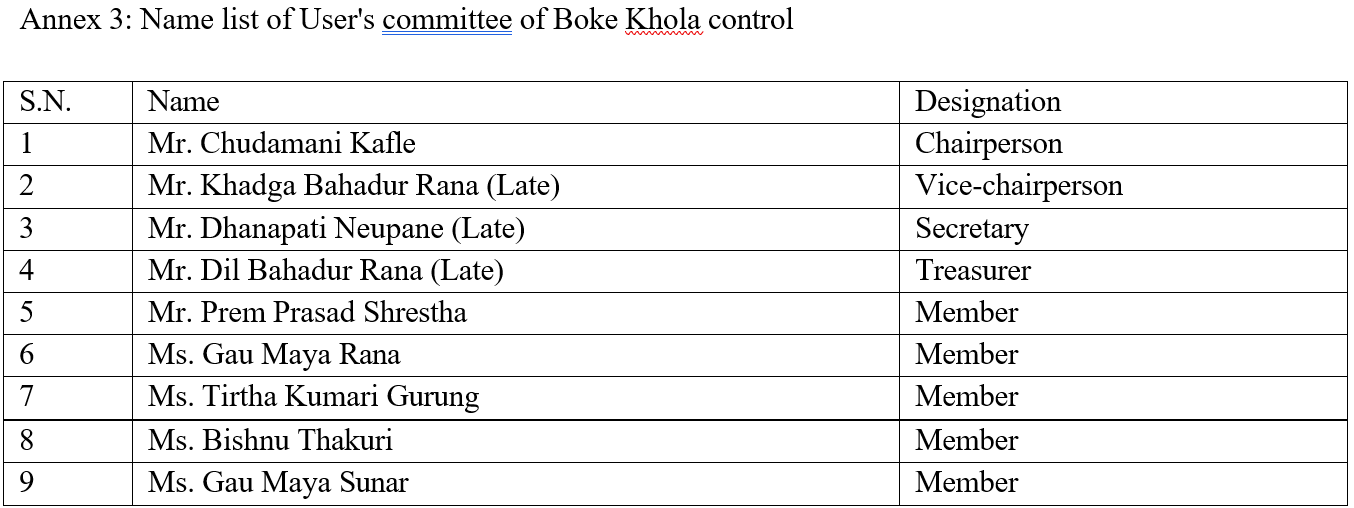
The project had three layers of office set up in respect to project headquarter, district and site office. In the project headquarter, District Soil Conservation Office (DSCO) Chief, JICA/JOCV Team Leader, experts, logistics coordinators were provisioned, whereas at district level DSCO chief, Field Manager, Engineer and Logistic Coordinator were arranged. Similarly, DSCO mid-level technician, JOCV volunteer and TOLI local volunteer were assigned at the site office level. The setup of the human resources at site office level was called monitor and promoter (M/P) team. The major roles of the M/P team was to assist information dissemination, formulation of sub-project, preliminary investigation of the sub-project, proceed proposal towards approval, facilitate to implement the approved sub-projects, submission of periodic report, monitoring and evaluation of the community level activities (JICA/CFWDP/JOCV, 1996). The M/P team received proposal of Boke Khola sub-project from user’s committee (Annex 3: Name list of user’s committee) and it forwarded to approval committee at district level. During agreement signing period, the M/P team informed the responsibilities to be borne by the project and user’s committee.
Following structures were constructed to control the Boke Khola sub-project:
i. Check dam construction: The project experts prepared design and estimate for check dams considering actual condition of the project site and demand of user committee. It encouraged the user’s committee and group to implement the activities enthusiastically. Accordingly, 5 gabions check dams of different height were constructed to trap the debris and gabion walls for stream bank protection was constructed in different parts of the 1000 m long flood damaged sections of Boke Khola.
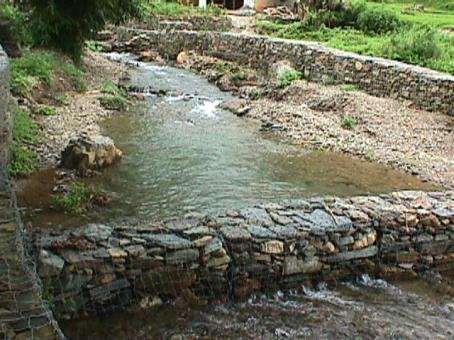
ii. Transportation and gabion boxes filling: The project transported gabion wire up to Walling, the last point of road head for the Triveni site office. The project site was located 27 KM west from Walling. It was very difficult to transport the wire mesh by the user’s group, because of far distance. So, the user’s committee sought another alternative of transportation by the mules, which was available there and on the other hand the user’s committee requested to bear 50% transportation cost by the project. Considering the genuine demand of the user’s committee, the project decided to bear 50% transportation cost by the project.
iii. Training on Gabion Box Netting to Local People: There was lack of skilled human resources for netting the gabion box in the So, the project conducted 10 days long gabion box netting training to the interested local persons in sub-project site.
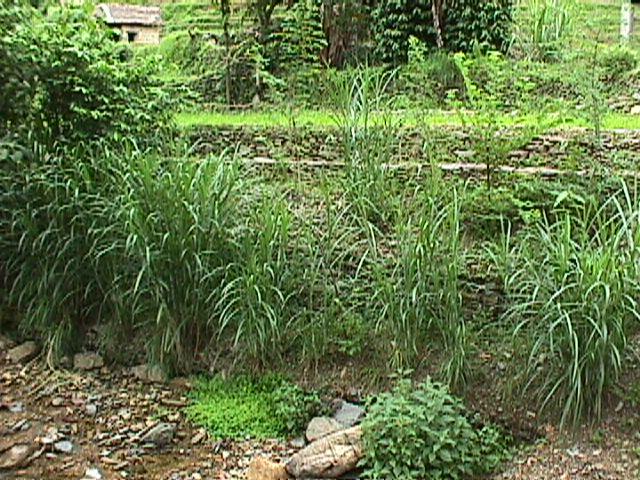
Due to hard nature of gabion box netting training (it needs more strength, stamina & patience) few of them withdrawn before completing the training courses. About 4 persons could able to complete the courses and got the employment for netting the gabion boxes. The project was supported to pay USD 12.5 each of the gabion box filling by stone on size of 3m3 (3x1x1 m). So, the people of neighboring wards and other VDC also were involved to fill the gabion boxes. Total 725 gabion boxes were prepared, out of them 685 number of gabion boxes were put about 1000 m length stream in both sides, as per estimation and rest of the gabion boxes were put in check dams.
iv. Nursery establishment and plantation: Besides that the project estimated to plant forest, fodder and forage grasses in the both sides of the Boke Khola and others wards as well. So, two nursery men Mr. Khadga Bahdur Rana and Mr. Dil Bahadur Rana were sent to then Mauja VDC (then site office of Kaski district) to participate in the nursery management training. The nursery men established two nurseries immediately and produced different types of forestry, fruits, fodder trees and forage grasses in Triveni VDC, after receiving the training.
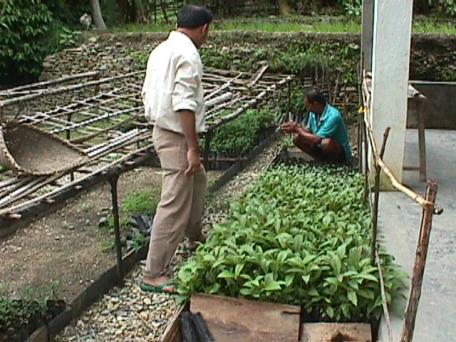
About 1000 Sissoo (Dalbergia sissoo), 400 Raikhaniyo (Ficus semicordata), 10 bamboo (Dendrocalamus spps.), 10 Nemaro (Ficus nemoralis) tree and 3500 sets Napier grass were planted nearby the Boke Khola to protect the soil erosion and promotion greenery for multi-purposes.
v. Construction of drinking water scheme: The project estimated a drinking water sub-project nearby in the bank of Boke Khola as per demand of the community people and secondary school students’ The secondary school is situated in nearby Boke Khola sub-project. A reservoir tank was constructed having capacity of 9000 liters. To construct the reservoir and water collection tank, cement, rod, wire and skilled labor cost was borne by the project, whereas stone, aggregate, sand and unskilled labor was borne by the user’s group. There were provisioned 3 taps, out of them, one for the public school and two taps for the community people purpose nearby the Boke Khola.
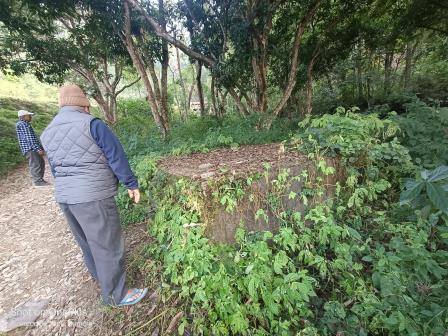
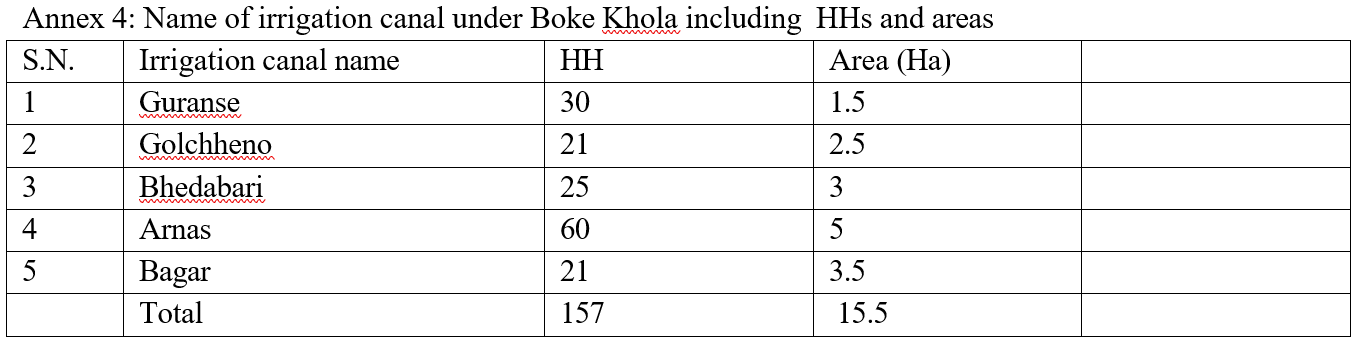
vi. Maintenance of Arnas irrigation canal: There were total 5 irrigation canals operated under water source of the Boke Khola (Annex 4: Name list of irrigation canal and irrigated land), out of them Arnas Irrigation System was damaged towards head parts of the canal due to flood, which alignment is just above of the Boke Khola. So, 200 m canal concretized and put slab in 100 m by the project for supplying the irrigation water permanently. This irrigation system irrigates 5 hectare of land.
F. Other infrastructures constructed nearby Boke Khola before and after the Boke Khola sub-project completion
- District Irrigation Division constructed central level irrigation system to irrigate about 7 ha of lands in 1992. The aqua duct is crossed over the Boke Khola.
- Then Triveni VDC constructed concrete bridge across the Boke Khola about 600 meter above from ending parts of the Boke Khola to cross the human and animals in 2004.
- The Paiyu Rural Municipality constructed iron made bridge across the Boke Khola about 200 m above from ending part Boke Khola to cross the community people and animals at the cost of USD 4412.00 in May 2017.
- Divisional Forest Office, Parbat constructed Children Park nearby the Boke Khola, which is about 750 m2 to play the secondary school students and community children in 2023.
- About 100 matured Sissoo trees were harvested to install high tension line nearby the Boke Khola by the Nirmal Secondary School.
Results and lessons learned
e.1 Changes in socio-economic condition of the community people after completion of the sub-project
a. Protected lands, resident and public properties:
Before project intervention namely, the Boke Khola sub-project, the stream used to erode cultivated land on both sides of the stream each year and sometimes, the flood water entered into the settlement damaging homes and animal-sheds. The individual owner used to control the eroded land by their own initiation like diverting stream water towards stream, putting stone against the stream, planting bamboo and shrubs in stream side, putting wood and bamboo against the stream, putting leaf litters pressing by stones and so on. Those controlling measure were not effective, so the flood used to damage agriculture land and settlement every year during rainy season.
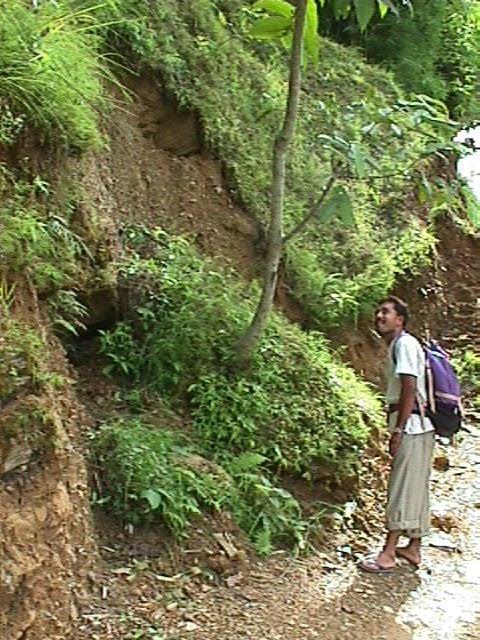
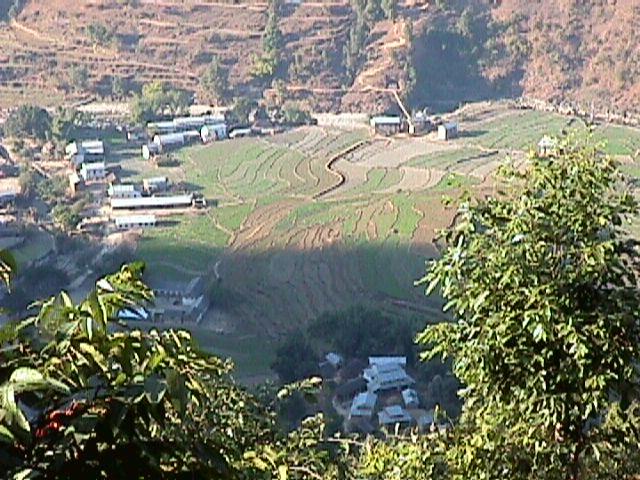
The Boke Khola sub-project protected about 15.5 hectare of irrigated land, where 157 household (HH) grows cereals, vegetables and oil crops. It also protected one secondary school, 25 households, 5 irrigation canals and drinking water system. As the result of this sub-project; bachelor level college established in 2009 and constructed about 125 additional houses including hotel, restaurants and grocery shops. Similarly the value of the land also increased dramatically. The road construction from Walling Syangja district to Bihadi RM Parbat through this area also accelerated to develop this area as a town.
b. Agriculture enterprises increased:
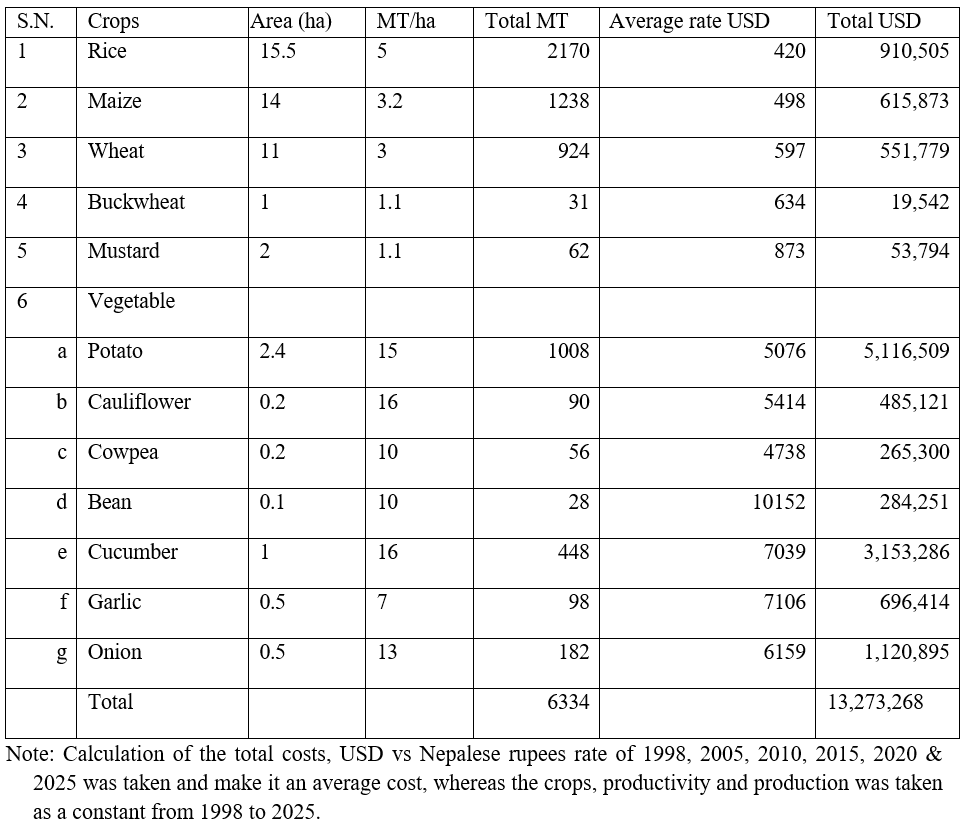
Under the Boke Khola, there were 5 irrigation canals, which are being operating throughout the year and irrigating 15.5 hectares of lands that are source of crops to 157 HHs. Major crops are cereal like rice, maize, wheat and buckwheat, oilseed like mustard and vegetables like potato, cucumber, onion, garlic, cauliflower, cowpea and bean. These crops are cultivated based on seasons in all around the year. Following are the crops, areas, productivity, total production, rate & total income under irrigated land of Boke Khola for 27 year’s (1998-2025):
c. Skilled human resources development:
As the project organized gabion wire netting training in Triveni, four number of the community people developed as gabion wire netting human resources. They were the first skilled human resource for netting the gabion boxes of those areas. Before that such work was performed only by Indian citizens. The trained human resources were employed to net the entire gabion boxes of Boke Khola sub-project. They involved similar activities conducted by different government organization and private consultancy, after completion the Boke Khola sub-project. Since long time, they are associated with the road construction companies for netting the gabion boxes as permanent human resources. Besides that, they trained so many other gabion wire netting workers through on the job training in these areas. Now, the local human resources replaced the Indian human resources for netting the gabion boxes in those areas.
d. Empowered women in social activities:
The project provisioned a policy of involving at least 50% women in each of the project activities through user’s committee, training, study tour, and full involvement in income generation activities. As a result, the women of the community built up skill for generating income and developed leadership skill and able to involve other committees beyond the sub-project, like community forestry user’s group (CFUG), drinking water user’s committee (DWUC), school management committee (SMC), road construction committee (RMC), etc. It ultimately changed the roles of women from being limited into household chores to an avenue for them to work as agent of social change in their society and beyond.
e.2. Impact of the Boke Khola sub-project in the biodiversity conservation and ecosystem
a. Multi-purpose utilization of water of the Boke Khola
Community people of Boke Khola sub-project have been utilizing the water in multi-purpose ways. They are using more than 15 hectares of lands for irrigation through 5 separate irrigation canals and drinking water to 150 families. Besides that the water is used to wash the clothes by community people nearby Boke Khola. The people also use the water for vegetable gardens, cleaning the utensil, pig farm, livestock shed and the domestic animal drinking purposes.
b. Greenery and biodiversity promotion
About 1000 Sissoo (Dalbergia sissoo) and 400 Raikhaniyo (Ficus semicordata), 10 bamboo (Dendro calamus spps.), 10 Nemaro (Ficus nemoralis) trees and 3500 stocks of Napier grass were planted nearby the Boke Khola sub-project. Similarly, user’s committee decided to restrict domestic animal for free grazing, so that planted trees and grasses could be protected. They announced fine USD 1.30 for goat and USD 2.50 for buffalo and cattle, if enter into the protected areas.
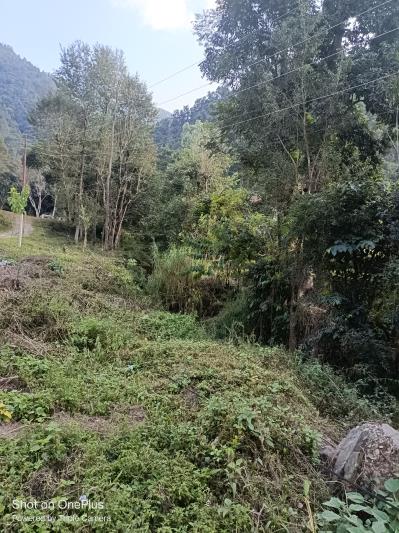
It controlled the free grazing effectively. As the result, above mentioned varieties of different trees and indigenous fodder trees like Thotne (Ficus hispida), Bedulo (Ficus palmate), Dabdabe (Garuga piñata), Tuni (Toona ciliata), Kutmiro (Litsea monopetala), forest tree like Lapsi (Choerospondias axillaries) Champ (Michelia champaca), Bhakyamlo (Garcinia indica), Pipal (Ficus religiosa), Khayer (Acacia catechu), Chilaune (Schima walichii), Lakuri (Fraxinus floribunda), Khirro (Falconeria insignis), Mauwa (Madhuca longifolia), Masala (Eucaliptus camaldulensis), Sami (Ficus benjamina), shrubs like Asuro (Rusticia adhatada), Dhurseli (Colebroken oppositifolia), Nilkanda (Duranta erecta), Bayar (Zizyphus mauritianna), fruits like mango (Magnifera indica), jack fruit (Artocarpus heterophyllus), guava (Psidium guajava) trees were conserved and promoted in Boke Khola areas. Besides that, forest, fodder, fruits trees and forage grasses produced in the two nurseries promoted greenery, improved environment, increased biodiversity and upgraded livelihood of then Triveni VDC through fruits and livestock farming.
For the first time there was heavy flood in Bokekhola after 26 years in 2024. The reason of heavy flood was construction of a new road nearby the Dodare Khola, the top of the Boke Khola. The piled soil, aggregates, stone and debris excavated during road construction were swept by the rain water. The debris was strong enough to sweep severely four check dams, out of five and about 80 meters long gabions boxes stream bank protection work constructed on the east side of the bank of Boke Khola in 1998.
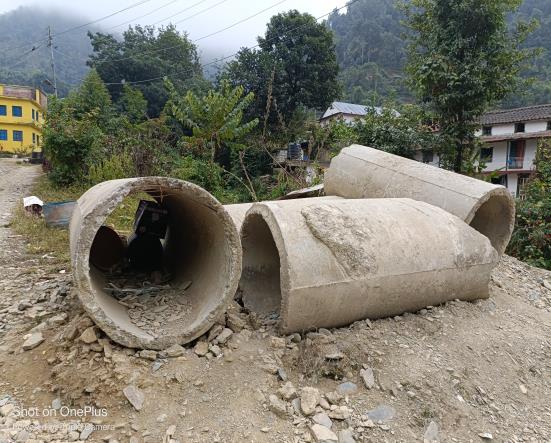
Similarly, the flood tilted about 35 gabion boxes towards center of the stream areas need maintenance. The flood also swept and felt down fodder, forest trees and forage grasses. The flood accumulated at the bottom of the Boke Khola, where a hum pipes culvert was constructed to cross the vehicles by the road division in 2022. The heavy flood accumulated in the bridge areas and that diverted towards the either sides of residents areas. Immediately, the Paiyu RM brought excavator and dismantled the hum pipes and drained the heavy flood towards Paiyu Khola and saved the residents areas from damaging. After occurring the huge flood, the delegation of community people of Boke Khola areas went to top of the source, where road was excavated. They complained the responsible persons of the areas and diverted the flood towards south catchment area on their consensus. This year, the flood was not occurred due to drainage provision. However, it is being hit gradually in the fragile parts. So, the possibility of devastation from flood is not stopped.
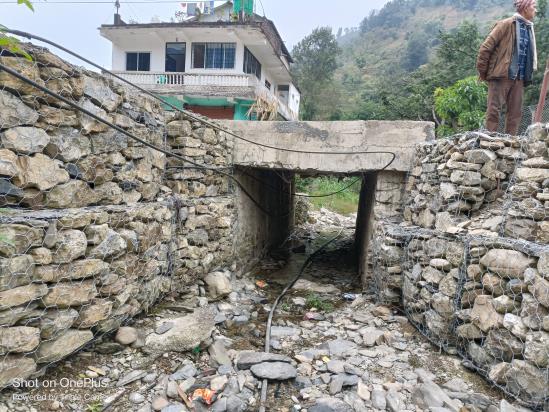
Currently, there are about 150 HHs around Boke Khola areas, most of the houses are built up of reinforced cement concrete (RCC). Most of the peoples are from vicinity of the areas. They are involving in different occupations like hotels, restaurants, groceries, service holder and farmers. Besides that, there are two educational institutions in respect to the bachelor level college having 150 students and secondary level school with 250 number of students.
c. Increased population of birds and wild animal
Vegetation of the areas promoted, which created habitats for the birds like crow, parrot, dove, mynah, nightingale, sparrow, owl, cuckoo, heron (Bakula), hornbill (Dhanesh), bulbul (Jurela), wood packer (Lahache), falcon (bajh), black drongo (chibe), common kingfisher, oriental magpie (Dhobini), white wagtail and wild animal like jackal, deer, monkey, leopard, lizard, mongoose, rat, squirrel, frog. During rainy season, the fishes of Paiyu Khola used to enter in Boke Khola that was unfortunately stopped, by constructing checks dam across the Boke Khola sub-project.
e.3. Lesson learned:
- Due to “need based support” of the project’s modality, community people motivated with tangible benefits received from the sub-project, so people participation found at high level in each sub-project, which accelerated to complete the sub-project before or on time. Further, the target groups will also involve in other priority activities/sub-projects with high motivation, if the project fulfilled their basic livelihood improvement related sub-projects.
- Provision of representation of women, Dalit (schedule caste) and Janajati (indigenous people) in decision making level, systematized sub-project implementation procedures and financial transparency, developed an ownership among the user’s group to their sub-project, which ultimately supported to the sub-project sustainability.
- Awareness on project implementation guideline is equally important among the project’s stakeholders to maintain uniformity and common understanding on project activities.
- Common understanding on responsibilities between the user’s group and project team and created conducive environment to implement the sub-projects efficiently and effectively.
- Empowerment of women, Dalit, Janajati and minorities is possible if the project will develop a policy of representing them in decision making and benefits sharing level.
- Possible risks assessment should be done periodically with appropriate precaution measures by the user’s group to protect the sub-project from the manmade and natural disasters.
- Human resources of any field of expertise need to be developed at local level for fulfilling the need of local people and employing them for the longer run.
Key messages
The Boke Khola was one of the successful sub-project under forest/watershed conservation sectors of the project, which was the collaboration between government of Nepal, JICA/JOCV and TOLI a NGO.
The project had developed project operational guideline to have uniformity and equal understanding among all the stakeholders concerning with this project. Since, it had provisioned to fulfill the requirement of the community people at first, so, the community people participated in each of the sub-projects with a high motivation.
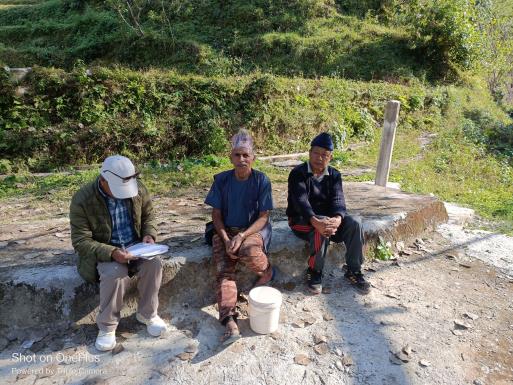
The project has provisioned of participating women in each of the project events by at least 50%, which empowered their capability and changed the domestic chores and role in the community and economic development aspects. The user’s group benefitted from the sub-project in many ways like easy access to drinking water, increased productivity due to irrigation in agriculture land, protection of stream bank with biological and engineering structures, restoration of degraded land by plantation, increased greenery, wild life species, birds and so on. The developed human resources for netting gabion boxes at local level not only getting the employment opportunity but also replaced the external human resources. Due to lack of risk assessment by the community people it faced a big disaster as a heavy flood, occurred in 2024, which need further support from local government and other stakeholders to fully maintain the damaged section. If the user committee does not manage the damaged parts of the Boke Khola on time, there is a possibility of entering the flood from fragile parts and damage cultivated lands, educational institutions and settlement area.
Refrences
CBS, 2021. Nepal National Population and Housing Census 2021, Centered Bureau of Statistic (CBS) Nepal
JICA/CFWDP/GPCP, 1996. Operational Guidelines. GoN/JICA/Community Development Forest/watershed Conservation Project (CDFWCP), GoN/JOCV/Greenery Promotion Cooperation Project (GPCP) phase I, Kaski & Parbat districts.