Yokohama Green-up Plan
01.12.2025
-
SUBMITTING ORGANIZATION
-
City of Yokohama
-
DATE OF SUBMISSION
-
October 2025
-
REGION
-
Asia
-
COUNTRY
-
Japan
-
KEYWORDS
-
Green Space Conservation and Creation, Forest, Agriculture, Greening
Summary Sheet
The summary sheet for this case study is available here.
Background
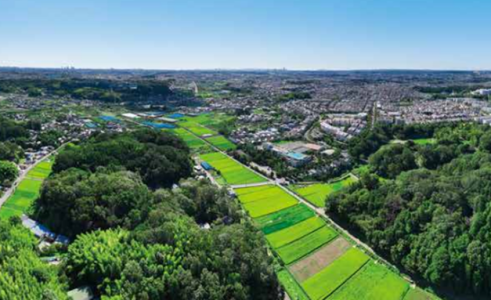
Yokohama is a large city that spans 438 km2 and has a population of 3.77 million, yet it also boasts woodlands, farmlands, waterfront areas, and other highly biodiverse natural spaces in locations closely connected to the day-to-day lives of its residents.
Sizeable tracts of forested and agricultural land stretch from the suburbs into the more developed areas of Yokohama, making it possible to enjoy these natural sights in many parts of the urban environment, while water originating from small valleys meanders across the city through numerous channels and rivers before pouring into the sea. Parks, rows of trees along roads, riverside recreational areas, creeks, and other appealing natural spaces are deeply intertwined with people’s everyday routines, forming a defining feature of Yokohama’s cityscape.
In the past, however, Yokohama’s proximity to Tokyo and convenient transportation networks gave rise to intense development pressures that shrank the city’s natural environment. To address this issue, the municipal government implemented various measures over the years for preserving and creating diverse green spaces. The city stepped up this commitment in fiscal 2009 with the launch of the Yokohama Green-up Plan, an ongoing action plan that provides a more concrete roadmap for conserving and adding green spaces.
Yokohama Green-up Plan
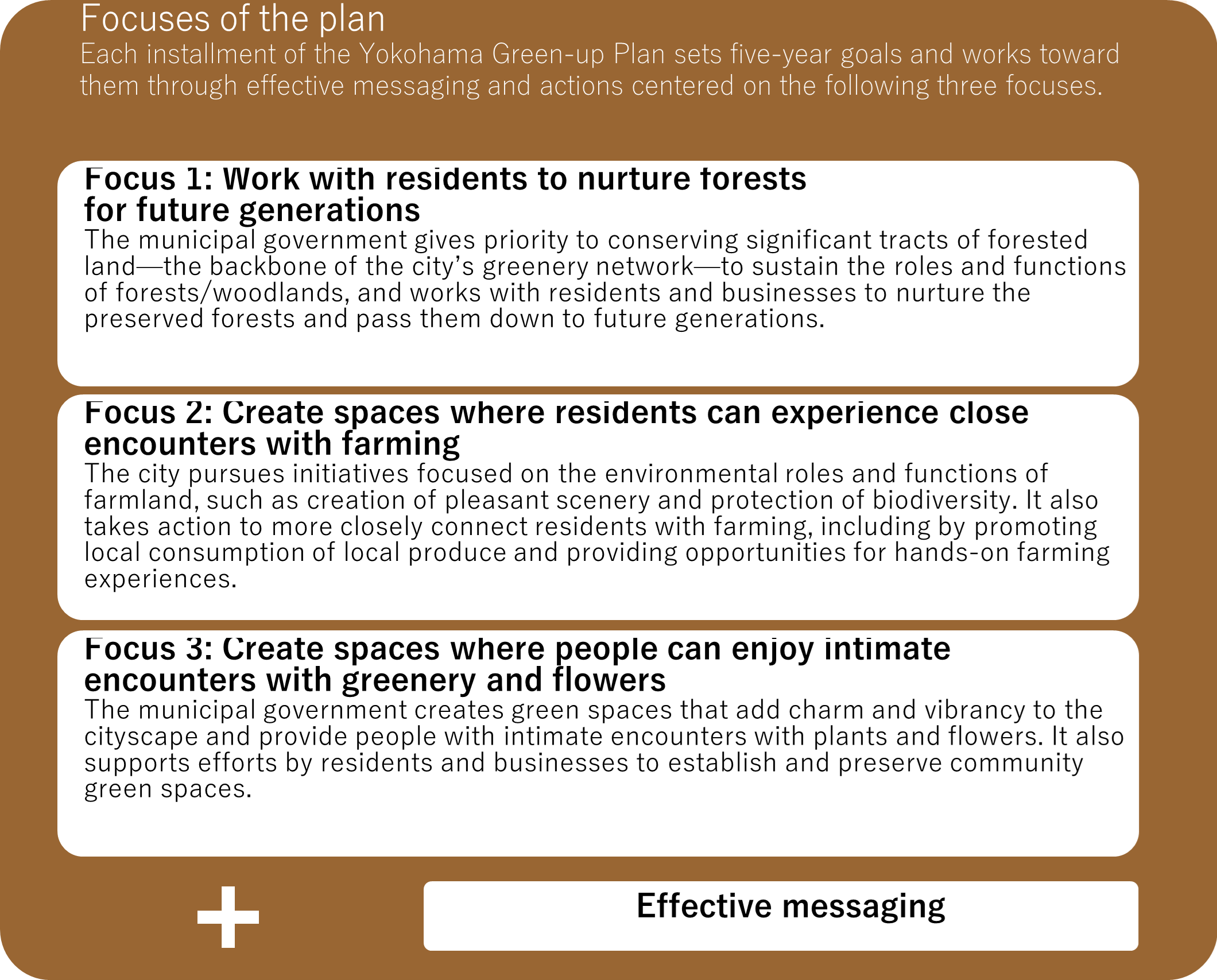
This plan is based on the ideal of making Yokohama a beautiful greenery-filled city that is nurtured by everyone, and carries out actions centered on the following three focuses.
Focus 1: Work with residents to nurture forests for future generations
The municipal government gives priority to conserving significant tracts of forested land—the backbone of the city’s greenery network—to sustain the roles and functions of forests/woodlands, and works with residents and businesses to nurture the preserved forests and pass them down to future generations.
Focus 2: Create spaces where residents can experience close encounters with farming
The city pursues initiatives focused on the environmental roles and functions of farmland, such as creation of pleasant scenery and protection of biodiversity. It also takes action to more closely connect residents with farming, including by promoting local consumption of local produce and providing opportunities for hands-on farming experiences.
Focus 3: Create spaces where people can enjoy intimate encounters with greenery and flowers
The municipal government creates green spaces that add charm and vibrancy to the cityscape and provide people with intimate encounters with plants and flowers. It also supports efforts by residents and businesses to establish and preserve community green spaces.
In addition to the aforementioned actions, the city also carries out effective messaging activities to increase resident awareness of the plan.
The plan is reviewed and renewed in five-year installments. The current and fourth installment covers the years from 2024 through 2028.
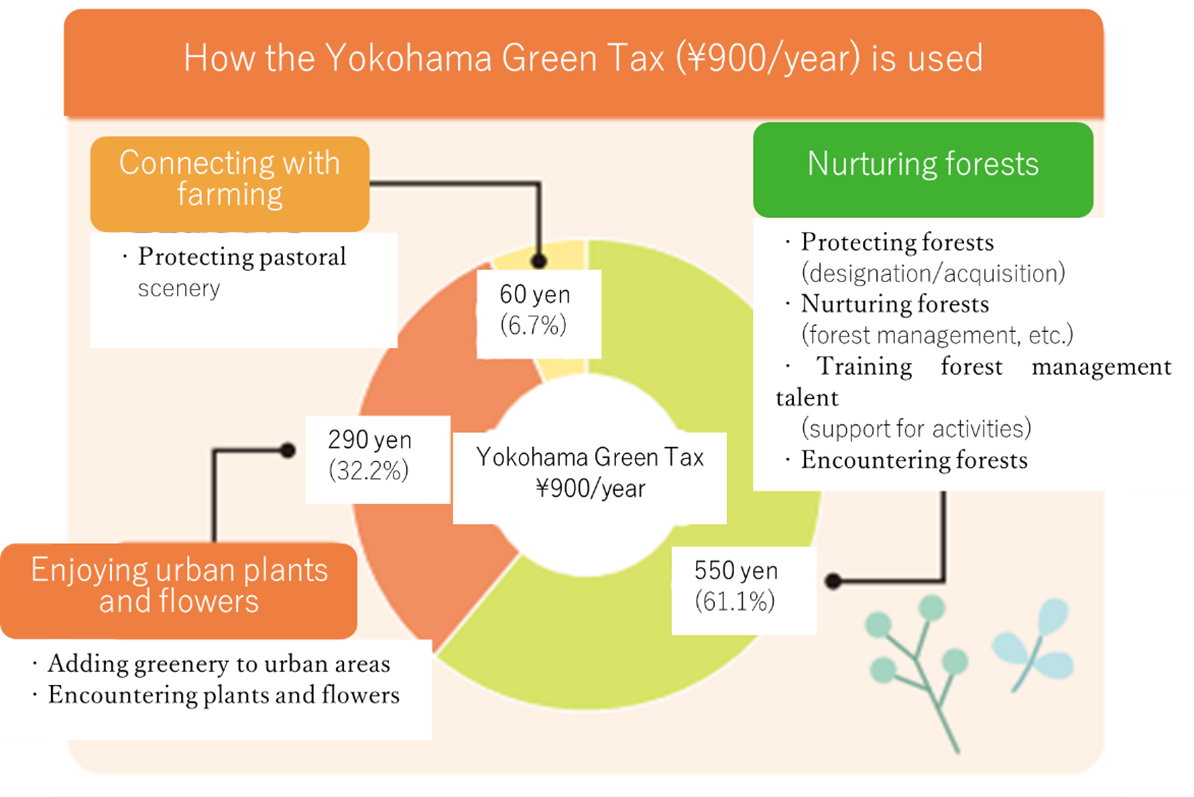
One distinctive feature of the plan is that it partially relies on a special municipal tax, the Yokohama Green Tax, to maintain a steady stream of funding for its efforts to protect and create green spaces.
This tax is collected on top of the flat-rate portion of the municipal inhabitant tax for individuals and corporations. Individual residents pay a fixed rate of 900 yen each year, while corporations pay an amount equivalent to 9% of their annual flat-rate portion.
Yokohama Green Tax revenues are apportioned to the three focuses of the plan for 2024–2028 as follows (percentages are approximate): 61% for Focus 1 (nurturing forests), 7% for Focus 2 (connecting with farming), and 32% for Focus 3 (enjoying urban plants and flowers).
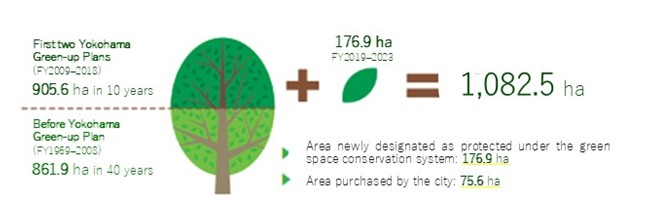
Over 1,000 hectares of woodlands were designated as protected land in the first 15 years of the Yokohama Green-up Plan. Today, the designation process is advancing at more than three times the initial rate.